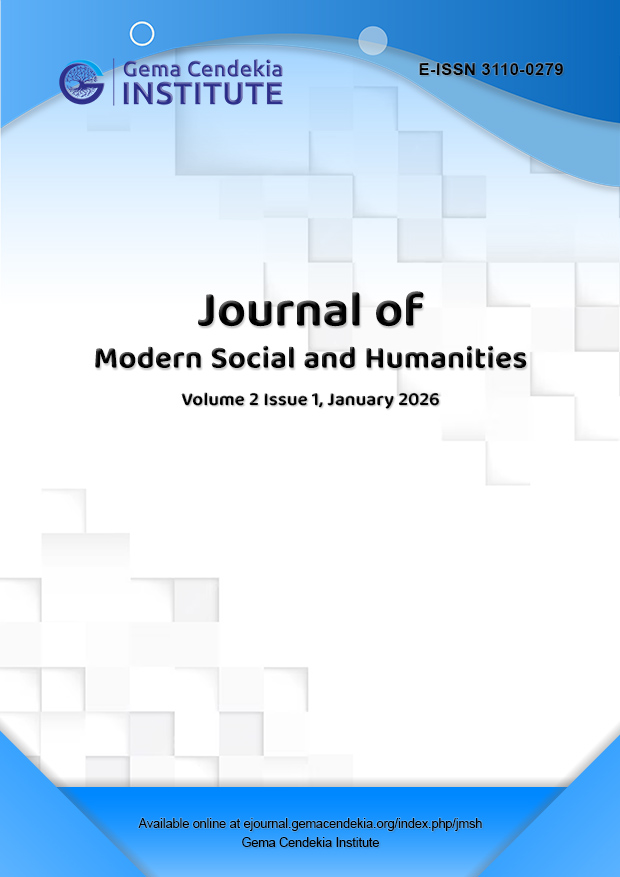
Pragmatik Banter di Voice Chat e-Sports: Batas Humor, Agensi, dan Keseimbangan Tim
DOI:
https://doi.org/10.71094/jmsh.v2i1.300Keywords:
Banter, Humor, Voice Chat, E-sports, Keseimbangan TimAbstract
Penelitian ini bertujuan untuk mengkaji pragmatik banter dalam voice chat e-sports, dengan fokus pada batas humor, agensi individu, dan keseimbangan tim. Melalui observasi langsung, wawancara dengan pemain, pelatih, dan manajer tim, serta analisis pragmatik terhadap percakapan voice chat, penelitian ini mengidentifikasi peran humor dalam membentuk dinamika tim dan kinerja pemain. Hasil penelitian menunjukkan bahwa humor dalam voice chat e-sports memiliki dua sisi: humor positif yang mempererat hubungan tim dan humor negatif yang dapat menyebabkan ketegangan. Agensi individu dalam percakapan juga memengaruhi bagaimana humor digunakan untuk memperkuat atau merusak keseimbangan tim. Temuan ini menyarankan bahwa pengelolaan humor yang tepat sangat penting untuk menciptakan komunikasi yang mendukung kolaborasi efektif dalam tim. Penelitian ini memberikan kontribusi penting dalam memahami bagaimana humor dan banter mempengaruhi kinerja tim dalam e-sports, dan menekankan perlunya pelatihan bagi pemain untuk menggunakan humor secara konstruktif.
References
Ceha, J., Lee, K. J., Nilsen, E. S., et al. (2021). Can a humorous conversational agent enhance learning experience and outcomes? Journal of Educational Technology, 22. https://doi.org/10.1007/S12110-018-9317-3
Dybala, P., Ptaszynski, M., & Rzepka, R. (2009). Humoroids: Conversational agents that induce positive emotions with humor. Proceedings, 40. https://doi.org/10.1109/taffc.2020.2994533
Dubrovskaya, T., & Yuskaeva, E. (2022). Language aggression in virtual professional communities. Training, Language and Culture, 10. https://doi.org/10.1177/1059601119854927
Gilmartin, E., Bonin, F., & Cerrato, L. (2015). What’s the game and who’s got the ball? Genre in spoken interaction. Proceedings, 8. https://doi.org/10.1007/S12110-018-9317-3
Hasan, K., Rahman, W., & Bagher Zadeh, A. (2019). UR-FUNNY: A multimodal language dataset for understanding humor. Proceedings, 34. https://doi.org/10.1145/3173574.3174120
Hickey, C., & Roderick, M. (2022). When jokes aren’t funny: Banter and abuse in the everyday work environments of professional football. European Sport Management Quarterly, 6. https://doi.org/10.1109/taffc.2020.2994533
Hoogeboom, M. A. M. G., & Wilderom, C. P. M. (2020). A complex adaptive systems approach to real-life team interaction patterns, task context, information sharing, and effectiveness. Group & Organization Management, 41. https://doi.org/10.1002/SYMB.396
Huston, C., Cruz, A. G. B., & Zoppos, E. H. (2023). Welcome to esports, you suck: Understanding new consumer socialisation within a toxic consumption collective. Journal of Marketing Management, 3. https://doi.org/10.22363/2521-442x-2022-6-4-62-72
Haugh, M., & Weinglass, L. (2018). Divided by a common language? Jocular quips and (non-)affiliative responses in initial interactions among American and Australian speakers of English. Intercultural Pragmatics, 20. https://doi.org/10.28914/ATLANTIS-2019-41.2.02
Irwin, S. V., Naweed, A., & Lastella, M. (2023). Consuming esports and trash talking: How do social norms and moderating attributes influence behaviour? Sport in Society, 3. https://doi.org/10.1016/j.dcm.2023.100700
Klíma, O. (2022). Whose voice matters? The gaming sphere and the Blitzchung controversy in eSports. American Journal of Cultural Sociology. https://doi.org/10.1080/17430437.2022.2200732
Kozlowski, S. W. J., & Chao, G. T. (2018). Unpacking team process dynamics and emergent phenomena: Challenges, conceptual advances, and innovative methods. American Psychologist, 136. https://doi.org/10.1515/IP-2018-0019
Lehmann-Willenbrock, N., Chiu, M. M., & Lei, Z. (2017). Understanding positivity within dynamic team interactions: A statistical discourse analysis. Group & Organization Management, 67. https://doi.org/10.1002/SYMB.396
Liu, S. (2023). You’re so mean but I like it – Metapragmatic evaluation of mock impoliteness in Danmaku comments. Discourse, Context and Media, 1. https://doi.org/10.1145/3411764.3445068
Marcolino, L. S., Jiang, A. X., & Tambe, M. (2013). Multi-agent team formation: Diversity beats strength? Proceedings, 86. https://doi.org/10.1145/3173574.3174120
Metatla, O., Bryan-Kinns, N., & Stockman, T. (2018). “I hear you”: Understanding awareness information exchange in an audio-only workspace. Proceedings, 10. https://doi.org/10.1037/AMP0000245
Mukherjee, S., Huang, Y., & Neidhardt, J. (2019). Prior shared success predicts victory in team competitions. Nature Human Behaviour, 46. https://doi.org/10.1037/AMP0000245
Nakandala, S., Ciampaglia, G. L., & Su, N. M. (2016). Gendered conversation in a social game-streaming platform. Proceedings, 62. https://doi.org/10.1007/S12110-018-9317-3
Pennock-Speck, B., & Clavel-Arroitia, B. (2019). Facework and prosocial teasing in a synchronous video communication exchange. Atlantis: Journal of the Spanish Association of Anglo-American Studies, 2. https://doi.org/10.1145/3411764.3445068
Ritschel, H., Aslan, I., & Sedlbauer, D. (2019). Irony man: Augmenting a social robot with the ability to use irony in multimodal communication with humans. Proceedings, 34. https://doi.org/10.1037/AMP0000245
Shibani, A., Koh, E., & Lai, V. (2017). Assessing the language of chat for teamwork dialogue. Educational Technology & Society, 26. https://doi.org/10.1515/IP-2018-0019
Santarra, T. (2016). Adapting plans through communication with unknown teammates: (Doctoral Consortium). Proceedings. https://doi.org/10.1057/s41267-023-00611-4
Suzuki, R., Ito, M., & Kodera, S. (2018). An online experimental framework for cooperative relationships with a real-time decision-making and rewarding environment. Frontiers in Ecology and Evolution, 10. https://doi.org/10.1037/AMP0000245
van Rooij, R., & Schulz, K. (2016). Analysing communicative diversity via the Stag Hunt. Proceedings, 1. https://doi.org/10.1145/3173574.3174120
Zhang, J., Chang, J., & Danescu-Niculescu-Mizil, C. (2018). Conversations gone awry: Detecting early signs of conversational failure. Proceedings, 168. https://doi.org/10.1145/3173574.3174120
Dynel, M. (2009). Beyond a joke: Types of conversational humour. Language and Linguistics Compass, 233. https://doi.org/10.1057/s41267-023-00611-4
Kniffin, K. M., & Palacio, D. (2018). Trash-talking and trolling. Human Nature, 31. https://doi.org/10.1057/s41267-023-00611-4
Lin, S., Xu, Z., & Xie, Z. (2023). Cultural diversity in semi-virtual teams: A multicultural esports team study. Journal of International Business Studies, 12. https://doi.org/10.1080/16184742.2022.2124299
Klíma, O. (2022). Whose voice matters? The gaming sphere and the Blitzchung controversy in eSports. American Journal of Cultural Sociology. https://doi.org/10.1080/17430437.2022.2200732
Downloads
Published
Issue
Section
License
Copyright (c) 2026 Andi Pratama, Siti Rahmawati , Muhammad Rizky (Author)

This work is licensed under a Creative Commons Attribution-ShareAlike 4.0 International License.